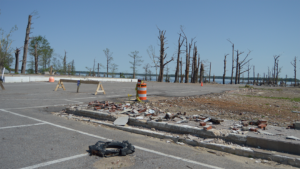
Blue Bank, Tenn. – Leafless cypresses stand in contrast to the greenery of spring as life starts to rebound in west Tennessee after a devastating EF4 tornado struck Arkansas, Missouri, Tennessee and Kentucky on Dec. 10.
The tornado killed 80 people in Kentucky. The tornado will have a lasting impact on the environment, especially on animals and plants like deer, songbirds, oaks and cypresses.
Reelfoot Lake State Park sustained heavy damage, said State Park Manager Alisha O’Dell. The damage focused on two areas – Blue Bank Day Use Area and Eagle Basin Day Use Area – with much of the damage happened to picnic shelters, bathrooms and playgrounds.
Trees downed by the tornado remain submerged five months later. Many trees were here before the 1811-1812 earthquake, which created the lake because they were in deep water that cypresses normally can’t grow in.

Many trees could not be cut down due to them being in the lake and cypress being a very hard wood. These trees will be left to rot to provide perches for birds like eagles, owls and hawks as well as educational tools for tours to talk about the tornado, O’Dell said. Dead and rotten trees provide excellent perches for these birds due to an unobstructed view of the area around it.
Downed trees not only affected aquatic life but birds, too. While it is hard to survey eagle populations and it is unknown if any bald eagles died during the tornado, at least one nest was destroyed by the storm which caused the eagles who built it to start rebuilding it at Eagle Basin.

O’Dell said the eagles building the nest made it in only a month when it normally takes three.
“It’s the fastest we’ve ever seen one build,” O’Dell said.
The downed trees, especially in the lake, will also benefit fish as these will become fish banks where fish go to hide and lay eggs. They also give areas for turtles and other semi-aquatic animals to rest outside of the water.
Eagle Basin remains closed with little cleanup or repairs due to the eagles moving in, which is also being closely monitored since the nest is close to TN hwy 22, which has interested researchers with the state park system.

With the exception of Eagle Basin, most of Reelfoot Lake State Park has been repaired and reopened. Eagle Basin remains closed due a protective zone to protect the eagle who nests there now.
Reelfoot Lake was the least environmentally affected park hit by the tornado.
Land Between the Lakes
Land Between the Lakes, a national recreation area, was struck by two tornadoes on the night of Dec. 10: an EF4 that came from the same supercell that hit Reelfoot Lake State Park and an EF3 that started in Dresden, Tennessee and hit LBL on the Tennessee side of the park and went on to hit Bowling Green, Kentucky.
The tornado did not damage as many buildings as Reelfoot Lake State Park, but it did damage more than 6,700 acres of forestland and 3,200 acres in Kentucky and another 3,700 acres in Tennessee.
Public Affairs Specialist Lewis Carlin said the damage on both sides was “catastrophic.”
Much of the land affected had to be surveyed and assessed as a majority of the downed trees will be sold as salvage, as most of the wood does not need to be cut and may not be of high quality. Most of the 66,138 hundred cubic feet (CCF), which is what the Forest Service uses to measure wood for sale, will be auctioned and sold as is.

The timber sales will help LBL recoup costs for cleanup and the repair of facilities and roads. It will also assist in emoving barriers for both animals and plants to recolonize the area disturbed by the tornado.
John Pollpeter, the lead naturalist at the Woodland Nature Station, said while the tornado affected many species, most of the negative impacts will be replaced with positive ones, especially for deer, turkeys and rabbits, which thrive in early successional forests, the first stage in forest cycles.
The big reason for the benefit to these species is the change in sunlight. In old growth forests, the canopy is so thick that very little sunlight reaches the forest floor which prevents things like bushes and other leafy, low lying plants from growing.
“Deer prefer edge,” Pollpeter said. “They prefer to browse on this leaf or that, and edge is perfect for that.”
Edge is where forests and clearing meet and is home to bushes and shrubs which many ground dwelling creatures eat.
Turkeys also benefit as they prefer open clearings where they can peck for insects in the ground.
This new environment will also help out the dwindling oak population. Oaks require a lot of sunlight when they start to grow, and this new environment will allow for this and to take over in the newly opened area, especially after the fast growing tulip poplars and cherry trees die off.

Clark’s River Refuge
The undeveloped Clark’s River National Wildlife Refuge located in Marshall County took a direct hit from a tornado that spawned from the same cell as the one that hit Reelfoot Lake and was also an EF4 tornado.
Much of the damage was in a very remote part of the refuge. There was damage to the park’s headquarters and bunkhouse which required repairs, as well as multiple vehicles that still need repairs.
Unlike the Land Between the Lakes and Reelfoot Lake State Park, Clark’s River National Wildlife Refuge has done little clean up except in the area around their headquarters. The area hit by the tornado was east of I-69 in what was an old sweetgum plantation, said Refuge Manager Michael Johnson.
The section of the abandoned plantation was to be harvested in two years and replaced with native species, but harvesting now would be hard due to the debris from fallen trees.
Most of the felled trees, most of which were sweetgum, will be left to rot as they have already become worthless due to flooding.
The down trees pose a short-term problem for many animals, especially deer, which have hard time navigating the cut the tornado made.
In the long-term, this should help deer and other animals that like early successional forests as the land becomes covered in brush and grass which deer like to eat.
Clark’s River National Wildlife Refuge’s decision to not clean up is already being looked at to be used for research to see how forests recover after a tornado hits and how it affects wildlife, Johnson said.


