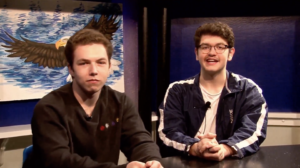
When an EF-4 tornado struck Mayfield last December, local and national media alike raced to document the damage. The minds behind Graves County Television — the student-led video production outfit at Graves County High School more commonly known as GCTV — opted for a different approach to their coverage.
Considering that a sizable chunk of the GCTV audience had personally endured the effects of the tornado in some form or fashion, Graves County educator and GCTV director Nick Miller decided that bombarding students and staff with persistent images of the then-fresh destruction could do more harm than good.
“I didn’t want GCTV to be this somber remembrance of everything that so many people in this building had experienced on a really raw level,” Miller said. “In hindsight, I’m not entirely sure it was 100 percent the right thing to do, but in that moment, it just felt really weird to continuously thrust into people’s faces.”
•••
Each episode of GCTV is produced in class the same day it’s uploaded to YouTube — ensuring students can quickly respond to community developments — and some especially enterprising students create comedic skits in advance. Uploaded the morning before the tornado struck, the Dec. 10 episode detailed such routine topics as the winter concert and prom.
Tornado-related school closures stretched into winter break and ultimately prevented the GCTV team from producing episodes for the rest of that month. Once the show had resumed production, said JT Handley — a Murray State television production student who was a senior at Graves County at the time — the news was already weeks behind them.
“There’s only so much that a high school news broadcast can really say on something that big,” Handley said. “I think one of the main things that people focused on in the class was trying to create short films and skits that were more fun, entertaining content.”
In fact, there seem to be no major discrepancies between content produced before and after the tornado. The most noteworthy mention comes from the Jan. 14 episode, in which sports anchor Noah Jones states that the last 16 seconds of a Marshall and Graves basketball game which had previously been postponed due to the tornado would be made up that evening.
Tonally, Miller described GCTV as a daily “up” for students who may face struggles at home. Especially in the aftermath of the tornado — when some displaced students were living in temporary accommodations an hour’s drive away — the show was intended to foster a sense of community among the young people of Graves County.
“When some of these kids left, it was like they were stepping right back into the reality of what happened on Dec. 10,” Miller said. “It just didn’t make a whole lot of sense to say, ‘Do you remember this thing that happened?’ Because you know that they did, but to maybe give them a little bit of an escape was not such a bad thing.”
•••
The night of the tornado, GCTV classmates kept in touch with each other and their instructor through the Discord instant messaging platform, where they shared photos of the then-ongoing destruction, much like people of Graves County documented their experiences on Facebook.
“It was just a really surreal experience,” Miller said. “I remember personally going through and, as best as I could, trying to contact everyone that I knew that lived in the areas where the tornado had tracked through, that were specifically my students.”
Israel Carr — now a film production student at Asbury University — was one such student who was adversely affected by the tornado. While his house, which primarily sustained roof damage, was not as badly damaged as his neighbors’, his family’s business, Carr’s Steakhouse on West Broadway, was destroyed after more than 60 years of operation.
“That night, I was closing, and 15 minutes after I closed is when it went down,” Carr said.
About a week later, the company launched a GoFundMe page to help several employees who had lost their homes or were out of work at that time. Carr’s Cafe opened in the WK&T Tech Park to employ some former staff until the original steakhouse could be rebuilt.
For one of his assignments, Carr gathered footage of both the destruction and relief efforts to juxtapose the bad with the good, yet he tackled this task with much the same regard for his classmates’ recent trauma as his instructor.
“If we ever did post stuff about it, it was more, ‘Hey, if you want to help, you can go this,’ and we kind of left it at that. Or, ‘Hey, this just got rebuilt, so congrats to them,’” Carr said. “It was never really like, ‘Oh, in case you’re wondering, our town is still damaged and everything.’”
•••
Although the tornado was infrequently addressed on GCTV, students were tasked with other video-gathering responsibilities during that time. Abby Lonsway and Ayden Dick contributed by producing a “thank you” video to accompany a toy drive spearheaded by His House Ministries and meant to benefit tornado survivors.
“This was a unique situation for us because I don’t think — up until that point, at least in the time that I’ve been here for three years — we hadn’t covered anything of that magnitude that hit so close to home,” Miller said. “It’s naturally a very delicate situation because you don’t want to put anybody in the public eye that doesn’t want to be, understandably.”
Despite having family in Farmington, Lonsway — now a senior at Graves County High School prepping for the television production program at Murray State post-graduation — said the toy drive was the first time she had seen the destruction firsthand. Although she lives in Calloway County, her mother teaches in Graves.
“For me, I felt like an imposter because I wasn’t really affected, per se, because I live in Murray. I didn’t have power for a few days, whatever,” Lonsway said. “These people lost their homes. It was terrible.”
As for Dick — who had also served as the group’s on-the-ground “weatherman” immediately following the tornado — he said the interviewing experience was emotionally intensive yet revealed positive qualities of his local community.
“We got a lot of good, heartfelt moments,” Dick said. “It was nice seeing people being able to bounce back with the community helping trying to do that.”
Given the particularly sensitive nature of this story, students were not permitted to capture toy drive attendees’ faces and exercised greater than usual grace during interviews. Miller said his students did a good job of making interviewees feel comfortable despite the circumstances.
“It’s not every day that you’re thrust into an interview where any question that you ask could have a heavy emotional toll on the person that you’re talking to,” Miller said. “That’s good real-world experience for them, especially if they decide to go into journalism. You’re often going to be put in situations where it’s going to be uncomfortable, and you have to figure out a way to navigate that and still get the information you need.”
GCTV also assisted in the production of a tribute video that aired during a Mayfield Independent and Graves County basketball game.
“It was this moment of both of these communities that have really strong rivalries — not out of hatred or malice or anything, but it’s been a part of our culture for so long — coming together as one unit, one community, acknowledging the pain and suffering that both had been through, and paying respects to several people who had unfortunately lost theirs lives that day,” Miller said.


1 comment
[…] When an EF-4 tornado struck Mayfield last December, local and national media alike raced to document the damage. The minds behind Graves County Television — the student-led video production outfit at Graves County High School more commonly known as GCTV — opted for a different approach to their coverage. Read more on 270 Stories. […]